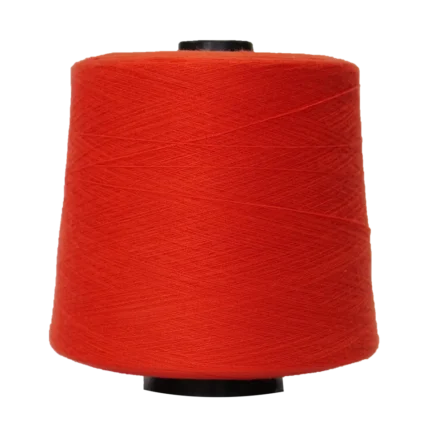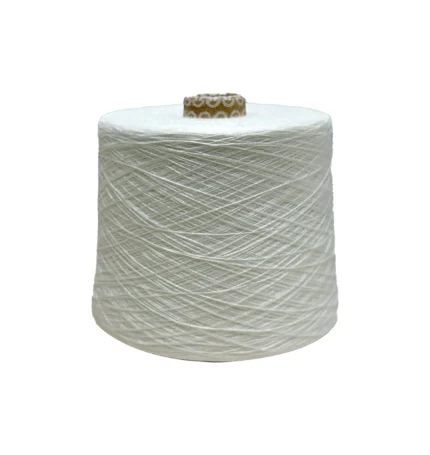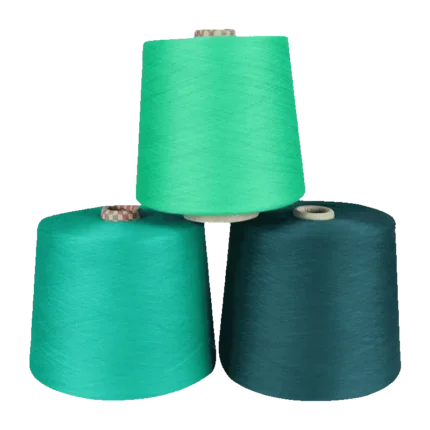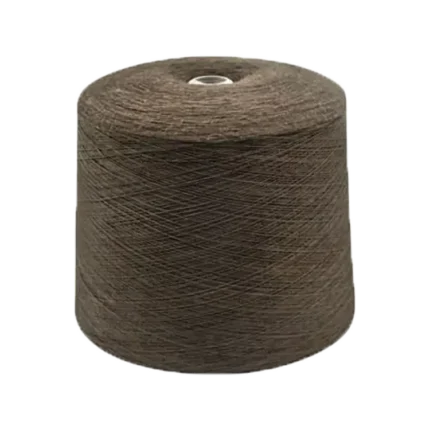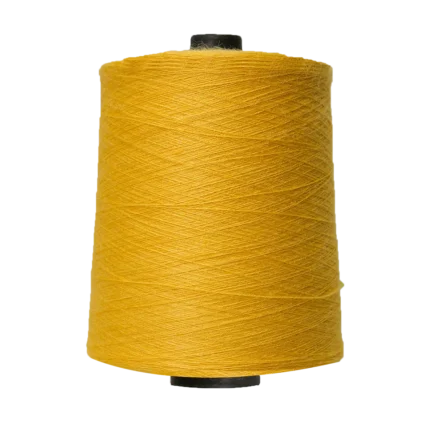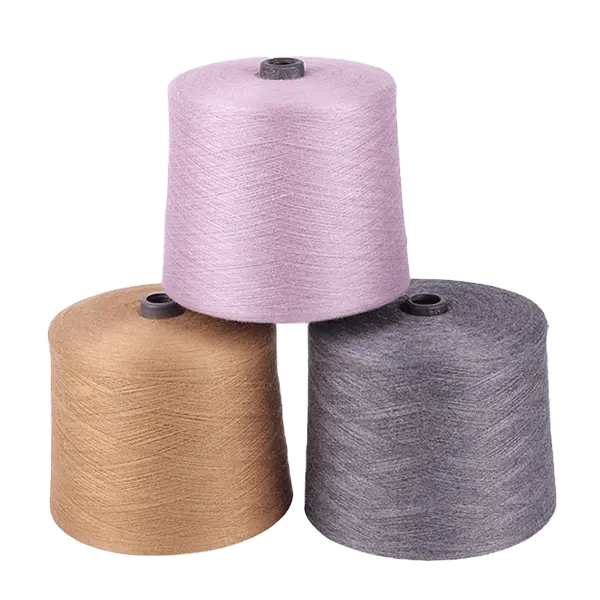
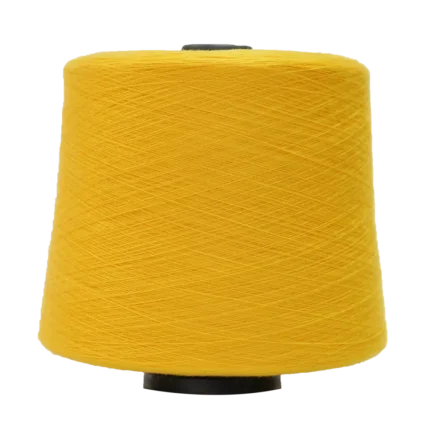
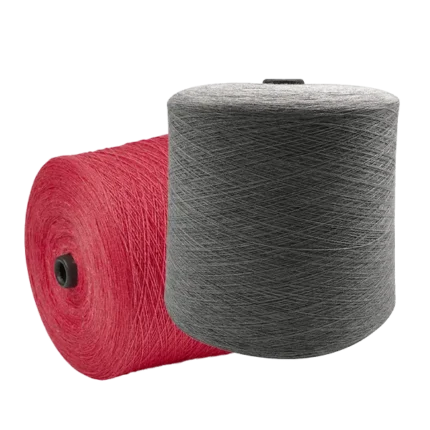
50% Viscose 28% PBT 22% Nylon Core Spun Yarn
Core-spun yarns are generally made of synthetic fiber filaments with good strength and elasticity as the core yarn, with short fibers such as cotton, wool, and viscose fibers being twisted together. The core-spun yarn has the excellent properties of filament core yarn and short-wrapped fiber
Introduction of 50% Viscose 28% PBT 22% Nylon Core Spun Yarn Product
Product Information
Features
- Excellent performance of filament core yarn
- Excellent performance of the outer short fiber
Uses
- Sweaters
- Socks
- Sheet
- Sofa cover
- Scarf
- Gloves
- Hats
Core Spun Yarn Definition
The core spun yarn definition in the textile industry is: A core spun yarn refers to a composite yarn combined by a core yarn and an outer yarn; generally with a filament as a core yarn, the short fiber is an outer yarn.

- core spun yarn structure
What is Core Spun Yarn
Core-spun yarns are generally made of synthetic fiber filaments with good strength and elasticity as the core yarn, with short fibers such as cotton, wool, and viscose fibers being twisted together. The core-spun yarn has the excellent properties of filament core yarn and short-wrapped fiber. The more common core-spun yarn is polyester-cotton core-spun yarn, which is manufactured from polyester filament as the core yarn and wraps cotton fibers. There is also spandex core-spun yarn, which is a yarn made of spandex filament as the core yarn and other fibers as outer yarn. The knitted fabric or jeans material made of this core-spun yarn can stretch freely and fit comfortably when wearing.

- core spun yarn
At this stage, under the competition of the yarn manufacturers, the core-spun yarn has developed into many types, which can be summarized as three types: short fiber and short fiber core-spun yarn, chemical filament and short fiber core-spun yarn, chemical filament and chemical filament core-spun yarn. At present, most core-spun yarns are generally composed of chemical fiber filaments as the core yarn and wrapped with various short fibers to form a unique structure of core-spun yarn. Commonly used chemical fiber filaments for its core yarns include polyester filaments, nylon filaments, and spandex filaments. The outer short fibers include cotton, polyester cotton, polyester, nylon, acrylic and wool fibers.
The structure of the core spun yarn
As above, the core spun yarn is manufactured by twisting staple fibers around a central core of the filament. This filament usually comprises polyester to give the additional strength that is required by the majority of textile products. In simpler words, this kind of yarn is made using twisting fibers around an existing yarn, creating a shell-core type of structure as the final product.
- Composite yarn of 3 different structures
The yarn has two main parts:
- Center or core: the continuous filament which is being covered by the twisting staple fibers is the core of the yarn.
- Sheath: The staple fibers are used as the sheath covering of the filament.
Both these parts contribute to providing the excellent performance that this thread offers.

- Core Filament and Outer Fiber of Core Spun Yarn
The continuous polyester filament used in between the wrapping staple fibers makes up approximately 60% of the thread construction which contributes to the following:
- Greater uniformity in strength, size, and other physical properties.
- Better ply security.
- Higher strength or tenacity per size compared to standard threads.
- Superior durability and abrasion resistance.
- Reduced seam puckering and better loop formation.
The outer fibers can be of staple polyester or staple cotton both. These outer fibers give the thread a fibrous surface which contributes in:
- Matte finish stitch appearance.
- Softer hand or feel than 100% continuous filament threads.
- Superior color fastness.
- Superior friction characteristics.
Core Spun Yarn Advantages
In addition to its special manufacturing process, core-spun yarn has many advantages. It can take advantage of the excellent physical properties of the core yarn (chemical fiber filaments), and the performance and surface characteristics of outer short fibers, which is a great way to give full play to the characteristics of the inner and outer fibers and make up for their shortcomings.
For example, polyester-cotton core-spun yarn has the advantages of polyester filaments, which are, crisp, crepe-resistant, and easy to wash and dry. Meanwhile, it can also take advantage of outer cotton fiber, so that it has good moisture absorption and low static electricity, and it is not easy to fuzz and pill. Obviously, it can utilize the different properties of chemical fiber filaments and the outer fiber.

- Core Spun Yarn Application in Sweater
Due to the difference between the inner and outer fibers, during the dyeing and finishing of the fabric, a part of the outer fiber is rotten by chemicals to a burnt-out exterior, and the fabric made of it is of a three-dimensional pattern appearance.
Its advantages are summarized as follows:
(1) It feels very comfortable, simulating the feel of expensive fibers such as cashmere, and can even achieve the effect of being fake.
(2) Cheap price is the biggest advantage of core-spun yarn. Guess how cheap it is? For example, the price of woolen wool this year is about 220 yuan per kilogram; for cashmere, it is about 850 yuan per kilogram; even the yarn with 60% wool is more than 40 yuan per kilogram. According to our 10+ years of experience in core spun yarn manufacturing, the price of core-spun yarn is only RMB 30 per kilogram.
These two biggest advantages have made core-spun yarn a kind of yarn that has been particularly favored in the past two years. Regardless of whether it is marketed or branded, many clothing manufacturers are using it. Of course, many high-end clothing may not use core-spun yarn, after all, the textile industry knows that it is a low-end category of yarn.
Here are some more advantages that this amazingly unique yarn has in store for you:
- Due to this yarn’s exceptional strength, the final product made using this yarn provides high performance.
- The wash and wear performance of the products made using this yarn is excellent.
- While maintaining and improving the properties of the fabric made using core spun yarn, it reduces its weight too.
- It is around 40 to 50 times tougher than the yarn that has the same weight.
- While stitching the denim seams and hems, the use of this yarn cuts down the number of broken stitches. This, in turn, paves the way for garments that are tougher than the standard ones.
- The yarn possesses excellent resistance to wear and tear.
- The use of this yarn improves the breathability and durability of the fabric.
Core Spun Yarn Disadvantages
To be honest, as a core-spun yarn supplier, we understand all aspects of its properties, and really can’t find out its big shortcomings. You said that core-spun yarn pilled, it does pilling; but it is undeniable that wool and cashmere will also pilling.
The only disadvantage of core-spun yarn, in my opinion, is that it is heavier. If you use it to make clothes, there will be the following unsatisfactory aspects:
(1) The fluffy feeling of clothes will not be as good as wool clothes.
(2) Clothes cannot be made into sweaters that are light and thick. If they are thick, the clothes will be very heavy, and they will feel tired when worn on the body.
Uses of Core Spun Yarn
Core-spun yarn is currently the most widely used product for knitwear manufacturing, due to its far low price compared with wool yarn and its good performance in garments. It can be used to produce school uniforms, work clothes, shirts, bathrobe fabrics, skirt fabrics, sheets and decorative fabrics. Bed sheets, bedspreads, pillowcases, sofa covers, curtains, tablecloths and other series of matching front bedding and interior decoration products made of core-spun fabrics through dyeing and printing are ideal high-end textiles.
According to the different uses of core-spun yarn, the current types of core-spun yarn mainly include: core-spun yarn for clothing fabrics, core-spun yarn for elastic fabrics, core-spun yarn for decorative fabrics, and core-spun yarn for sewing threads. There are also many spinning methods for core-spun yarn: ring spinning, electrospinning, vortex spinning, self-twisting spinning, etc. At present, China’s cotton spinning industry mostly uses cotton ring spinning to spin core-spun yarn.

- fabric made of rabbit hair core spun yarn
There are tons of daily life applications where core spun yarn is used:
- Since the most common combination used in the core spun yarn is polyester as the core and cotton as the skin, it can easily be used to make work clothes, students’ uniforms, shirts, bathrobe fabrics, etc.
- Due to their excellent durability, core spun yarns are also used in producing leather products such as women’s shoes, handbags, etc.
- The immense strength and durability of the products made using this yarn make it suitable to be used for rice bags too.
- Core spun yarns are mostly preferred for denim because it is around 40-40% stronger than the threads used of the same size, provide superior sew-ability on manual and automatic machines both, and there are very few interruptions and fewer restitched seams, also allow the use of smaller diameter thread, and helps in minimizing broken stitches and cuts in the final product.
Core Spun Yarn Type
According to the different uses of core-spun yarns, the main types of core-spun yarns currently include: core-spun yarns for apparel fabrics, core-spun yarns for stretch fabrics, core-spun yarns for decorative fabrics, and core-spun yarns for sewing threads. There are also many spinning methods for core-spun yarn: ring spinning, electrostatic spinning, vortex spinning, self-twist spinning and so on. At present, China’s cotton spinning industry mostly uses cotton ring spinning to spin core-spun yarn. However, there are still many core spun yarn manufacturers focusing on some special kinds of products.
1 Classification by product use
It can be divided into core spun yarn for sewing, core spun yarn for rotten fabric, elastic fabric (including knitted fabric, woven fabric) core spun yarn, fancy core spun yarn (such as hollow core-wrapped yarn, multi-color core spun yarn, bamboo core spun yarn, etc.), functional and high-performance fabric core spun yarn, etc.
2 Classification by core filament
In this case, core spun yarn can be divided into rigid core-spun yarns and elastic core-spun yarns. The former include polyester, acrylic, nylon, etc., and the latter includes spandex, PTT fiber, PBT fiber, etc.
3 Classification by outer fiber
Usually, the outer fiber contains cotton, wool, silk, hemp (including ramie, flax, hemp, etc.), colorful cotton and other natural fibers; Sticky fiber, MODAL, TENCEL, soybean fiber, milk fiber, bamboo pulp fiber, polyester fiber, acrylic fiber and all kinds of colored chemical fiber can be used for core-spun fiber.
4 Classification by spinning equipment
At present, ring spinning, rotary spinning, friction spinning, air jet spinning, and other spinning devices can be used to produce different kinds of core-spun yarn. The different spinning devices are basically the same.
5 Classification by filament (the core yarn) content
Filament content is the main index of core-spun yarns, which has a great influence on yarn performance and cost. For example, the spandex core spun yarn uses the spandex yarn as the core yarn. Generally, core spun yarn with filament content below 10% is called low ratio core-spun yarn; that with filament content of 10%~40% is called medium ratio core-spun yarn; that with filament content over 40% is called high ratio core-spun yarn.
Filament content of elastic core-spun yarn is generally less than 10%, 3%~5%, the higher the proportion, the higher the cost. Pure polyester sewing core-spun yarn is of filament content up to 50~60%. The filament content of the core spun yarn used in the rotten fabric is 40~60%, and that of general rigid core spun yarn is 20~40%. The filament content of core spun yarn should not be too high, and is restricted. Theoretically, the covering width of the outer fiber should be larger than the surface perimeter of the core filament yarn, otherwise, defects will occur.

- Spandex Core Spun Yarn
6 Classification by yarn density
In the same classification method as traditional yarns, core spun yarns of 32tex and above are classified as coarse special core spun yarns, those of 21-30tex are medium special core spun yarns, and those of 11-20tex are fine special core spun yarns. The density of core-spun yarn is normally between 16tex and 70tex. You might need a yarn count converter.
Common Core Spun Yarn Specifications
Below are the common specifications that most core spun yarn manufacturers provide in China.
|
Product name |
Composition |
Count |
|
Product name |
Composition |
Count |
|
Rabbit cashmere high-elastic core spun yarn |
Viscose polyester nylon |
28S/2 |
|
Wool velvet core spun yarn |
10 wool 40 anti-pilling acrylic 28PBT 22 nylon |
28S/2 |
|
High twist core spun yarn |
Visocse polyester |
28S, 60S, 80S |
|
Modal core spun yarn |
25 Modal 25 Viscose 22 Nylon 28 Polyester |
28S/2 |
|
Cotton core spun yarn |
Cotton |
28S/2 |
|
Cashmere core spun yarn |
10 wool 45 viscose 25 nylon 20 polyester |
28S/2 |
|
Color dot core spun yarn |
55 viscose 32 nylon 13 polyester |
28S/2 |
|
Three strands of rabbit hair core spun yarn |
51 viscose 28 polyester 21 nylon |
32S/2 |
|
Glitter core spun yarn |
47 viscose 22 nylon 26 polyester 5 flashing silk |
28S/2 |
|
Modal & cashmere core spun yarn |
Modal cashmere viscose polyester nylon |
28S/2 |
|
Slub core spun yarn |
50 viscose 23 nylon 27 polyester |
24S/2 |
|
AB symphony core spun yarn |
20 acrylic 20 nylon 27 polyester 33 viscose |
28S/2 |
|
Sequin rabbit hair core spun yarn |
43 viscose 36 polyester 21 nylon |
15S/1 |
|
Silver core spun yarn |
30 viscose 20 nylon 20 polyester 30 silver wire |
28S/2 |
|
Rabbit hair core spun yarn |
51 viscose 28 polyester 21 nylon |
28S/2 |
|
Alpaca core spun yarn |
42 acrylic 28 nylon 30 polyester |
18S/2 |
|
High elastic core yarn |
50 viscose 28 polyester 22 nylon |
28S/2 |
|
Anti-pilling fiber velvet core spun yarn |
50 anti-pilling acrylic 28 polyester 22 nylon |
28S/2 |
The difference between core spun yarn and covered yarn
The difference between core-spun yarn and covered yarn, we take spandex core-spun yarn and spandex covered yarn as examples:
Spandex core-spun yarn is spandex wrapped with short fibers, with spandex as the core and non-elastic short fibers outsourcing. When the spandex core-spun yarn is stretched, the core yarn is generally not exposed.

- Core Spun Yarn and Covered Yarn
Spandex covered yarn is an elastic yarn formed by covering the spandex with the filament of chemical fiber, which is also made of spandex as the core, and the non-elastic staple fiber or filament is wrapped in a spiral manner to cover the elongated spandex yarn. The core filament of covered yarn will expose when being stretched.
The core-spun yarn has poor elasticity, but the core yarn is not easy to be exposed to produce aurora; covered yarn is easy to produce aurora, but the elastic elongation ability is better.
Core spun yarn manufacturing process in our factory
As a core-spun yarn factory, we feel it is necessary to show everyone the production process of core-spun yarn, so that everyone can better understand what kind of core-spun yarn is. The following is a brief description of the core spun yarn production process, you can also click here to learn more about the core spun yarn production process.
In our core-spun yarn factory, the production of core-spun yarn is divided into the following processes:
opening and cleaning→ carding→ drawing→ roving→ spinning→ post processing.
After this series of processes, the selected staple fiber will eventually become the finished core-spun yarn.

- Core Spun Yarn Factory of Salud Style
1 Opening and cleaning process
The first process is opening and cleaning, which can mix the different fibers and make them into a uniform fiber bundle, as well as remove the impurities. This process will last 3 times to ensure core spun yarn purity. We control the workshop moisture and temperature in all the processes to ensure the yarn strength and quality. In this process, the short fiber is made into a uniform fiber roll to create conditions for carding process.

- core spun yarn opening and cleaning process
2 Carding process
After the opening and cleaning process, the fibers were loose and contained 40% to 50% impurities. Carding process can mix the fibers evenly and bundle them with a single fiber that is parallel to normal, while also removing impurities with strong adhesion. The fiber bundles will go through the carding machine, to make themselves completely decompose into single fibers. The product after this process is a card sliver. It is worth noting that the humidity setting of this process will affect the quality of the final core-spun yarn, and the humidity needs to be set according to the fiber composition of the core-spun yarn.
3 Drawing process
The quality of the card slivers is not good enough, and it needs to be processed into the drawn sliver. We will operate the drawing process 2 times to ensure the yarn is of great evenness. In the drawing process, after the fiber strip is mechanically processed, the distance between the fiber and the fiber becomes closer, and the mixed composition and color of the fiber are more uniform. The treated fiber strips are wound into appropriate packages for use in subsequent processes of core spun yarn manufacturing.

- core spun yarn drawing process
4 Roving process
Next is the roving process, where the drawn sliver is processed into roving yarn, preparing for the spinning process. The main task of the roving process is to stretch and draw the fiber strips according to certain technical parameters, improve the parallel elongation of the fiber, and at the same time, the fiber gets the appropriate twist and is wound into shape, so as to facilitate the storage and use of the next process. In the spinning process, the rovings here will be processed into core spun yarns as outer fibers together with the core yarns.